

What if your employees unwittingly smuggled in a major cause of enterprise risk? That’s the danger of shadow AI: chatbots or agents that workers bring into your organization without IT’s approval or oversight.
Beyond vexing your IT team who hate being left out of the loop (we’ll admit it), shadow AI is a mounting cyberthreat with real-world consequences. IBM’s Cost of a Data Breach Report 2026 found that 43% of security incidents involved shadow AI with impacts including:
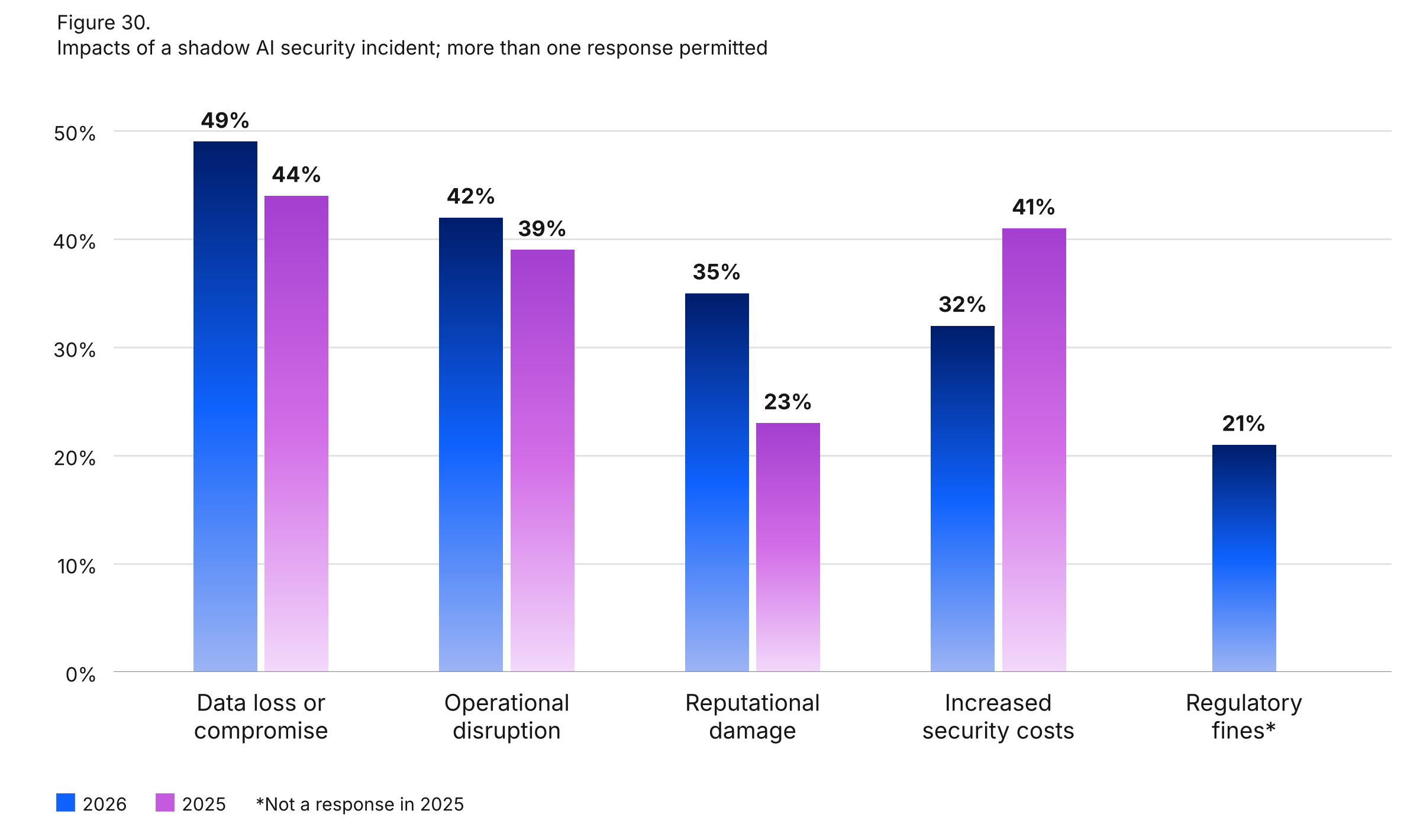
As these unsanctioned AI tools rise in prominence, organizations need to identify the risks and prepare guardrails to prevent shadow AI from catching them off guard. Here’s what your organization needs to know.
What is shadow AI?
Imagine a stranger has been living in your attic. Maybe they limit themselves to a midnight snack of Oreos and Mr. Pibb. Or maybe they strip the walls for copper and poke holes in your roof for airflow. Either way, nobody invited them, and you have no idea what they’re up to.
That stranger is shadow AI, which is any artificial intelligence tool that employees adopt on their own initiative and use with company data. Because these tools operate outside your security stack, any data your people feed them slips out of your visibility the moment they hit enter.
Most of what falls into shadow AI territory is fairly commonplace:
- It’s the personal ChatGPT account a paralegal uses to redline a client’s confidential merger agreement
- It’s the private version of Gemini Transcribe used to turn audio notes from patients’ appointments into text
- It’s the Merlin browser extension that summarizes every email in a controller’s inbox, including client banking details
These and other equally insidious examples can put your business at risk of data leaks, breaches, security vulnerabilities, regulatory noncompliance, and reputational damage. If you don’t identify shadow AI fast enough, the damage can quickly compound.
What happens when shadow AI goes unchecked?
Unfortunately, all it takes is one time for shadow AI to do harm, and companies don’t always have the chance to act quickly to prevent catastrophe. Here are two cautionary tales:
Amazon
In January 2023, while Amazon was still trying to acclimate to generative AI and define its internal use, some of their employees stumbled into early shadow AI quicksand. The tech giant showed a pop-up warning whenever employees visited ChatGPT (“may not be approved for use by Amazon Security”), but some bypassed it by clicking “Acknowledge.”
Some employees surmised that they weren’t supposed to paste confidential information into the tool, but others barreled forward, caution to the wind, and fed ChatGPT internal lines of code, interview questions, and other proprietary information. Amazon only caught the issue when a company lawyer noticed ChatGPT responses that closely resembled internal Amazon data. Employees were formally warned and AI usage policies were eventually updated, but that horse had already left the barn.
Community Bank
In May 2026, Community Bank, a Pennsylvania-based subsidiary of CB Financial Services, discovered that an employee had run sensitive customer information (including Social Security numbers and dates of birth) through an AI tool the bank had never approved. Though the employee had access to approved AI tools, they chose to mock up a presentation with their own personal account.
The lightning-quick reflexes of the bank’s leadership appear to have prevented the PII from being used to train the AI model. They may not be so lucky in the future.
In both cases, these organizations had rules, but all it took was one employee (or more likely a few) thinking they knew better or looking for a faster way to get the job done.
How do you deal with shadow AI?
So, how do you evict squatters you don’t know are in your house? Getting shadow AI under control starts with visibility and ends with habits your people will actually keep.
Take stock of every AI tool in use
Start by finding out which AI tools are already running in your environment. Chatbot tabs are the easy part. Browser extensions and AI features surreptitiously switched on inside software you already license are far easier to miss.
Once your inventory is compiled, keep it current. It doesn’t take much for accuracy to decay, especially with new AI tools launching every week. A one-time audit is a surefire way for visibility to go stale in a few months. EY found that 39% of formal AI assurance reviews (typically done annually) uncovered shadow AI. Assigning an owner to revisit the inventory on a regular cadence drastically reduces risk.
Give employees an approved front door
Amazon’s pop-up proved that a warning screen won’t stop someone on a deadline. People reach for shadow AI because it helps them work faster. Give them a sanctioned version of their preferred AI tool, especially one that fits within workflows, and they’ll be far less likely to scrounge up high-risk alternatives.
Provision business-grade AI accounts for the work your teams are already trying to do. As we covered in what your AI governance policy needs, a paid personal subscription still runs on consumer terms, which often allows AI vendors to train on your conversations, holding onto that data for years. The terms of most business AI plans respect privacy and ownership of your inputs and outputs, preventing them from being used in model training. And if there’s a breach, the vendor carries contractual responsibility.
Put the rules in plain language
Employees can’t follow rules that don’t exist and won’t follow rules that take a lawyer to decode. Your AI governance policy should spell out which tools and accounts are approved and what data can never go anywhere else.
Give people a simple gut check, too. Before pasting anything into any AI tool, ask one question: Would you post this on a public website? If the answer is no, it stays inside approved systems.
Keep the lines of communication open
Amazon only learned about its problem when ChatGPT started echoing internal data back. The sooner you hear about a slip, the more options you have to contain it. Encourage employees to bring new AI ideas to IT and to report mistakes the moment they happen, and treat those reports as a win. If people fear punishment, they’ll hide their mistakes, and your stranger in the attic gets to stay a little longer.
Plus, ongoing security awareness training keeps these habits fresh as new tools and threats emerge.
Evict unauthorized AI with Cubex Group
Cubex Group can detect shadow AI usage within your environment and identify users accessing unsanctioned AI tools, so you know where the gaps are before you write the rules to close them. You don’t have to build your policy from a blank page either. Our Acceptable Use Policy template gives you a ready structure to adapt to your business.
Is shadow AI already squatting in your attic? Reach out, and we can help you find unauthorized tools and set house rules that protect your business.
What are some common examples of shadow AI?
Shadow AI often looks like everyday productivity. It could be a paralegal using a personal ChatGPT account to redline a confidential merger agreement, or a browser extension that summarizes every email in a controller’s inbox, client banking details included. Any AI tool employees adopt on their own and use with company data qualifies.
Why do employees use unapproved AI tools when approved ones are available?
Usually because they want to work faster. At Community Bank, an employee with access to approved AI tools still ran customer Social Security numbers through a personal account to mock up a presentation. It only takes one person looking for a shortcut to put sensitive data at risk.
Can warning pop-ups stop employees from using unapproved AI?
Pop-ups alone won’t hold up against someone on a deadline. Amazon displayed a warning whenever employees visited ChatGPT, and some clicked “Acknowledge” and pasted internal code and proprietary information anyway. Sanctioned tools that fit your team’s workflows remove the reason to click past the warning.
Is a paid personal AI subscription safe for company data?
No. Paid personal subscriptions still run on consumer terms, which often allow AI vendors to train on your conversations and retain that data for years. Business-grade plans respect your organization’s ownership of its inputs and outputs and keep that data out of model training.
How often should you check for shadow AI?
Continuously. New AI tools launch every week, so a one-time audit goes stale within months. EY found that 39% of formal AI assurance reviews, which typically happen once a year, uncovered shadow AI. Assign an owner to revisit your AI inventory on a regular cadence.
What should employees ask themselves before entering data into an AI tool?
One question: would you post this on a public website? If the answer is no, the data stays inside approved systems. A simple gut check like this is easier to remember in the moment than a dense policy document.